



The GST rationalisation will benefit the state across multiple sectors — from traditional handlooms, handicrafts, coir, and fisheries to modern industries such as automobiles, electronics, renewable energy, and defence. It will reduce consumer prices, improve MSME margins, and make exports more competitive.
By easing costs for both households and industries, the reforms are set to strengthen rural livelihoods while boosting the state’s position as an industrial hub. With its blend of heritage and modern manufacturing, Tamil Nadu is expected to be among the key beneficiaries of the GST cuts — in line with the vision of Atmanirbhar Bharat and Viksit Bharat 2047, according to a release by the Centre.
The reforms slash GST rates to 5% or nil across textiles, handicrafts, coir, processed food, dairy, fisheries, and key industrial inputs — making goods cheaper and boosting competitiveness. The move is poised to benefit millions across the state — from handloom weavers in Kanchipuram and knitwear workers in Tiruppur to auto sector employees in Sriperumbudur and defence engineers in Avadi.
Textiles and handlooms
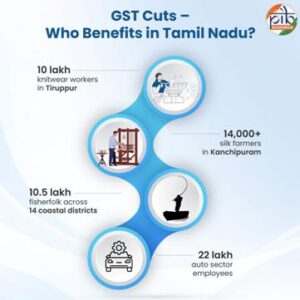
Tamil Nadu’s massive textile sector, which sustains millions of livelihoods, stands to gain significantly. In Tiruppur, where nearly 10 lakh people are employed in cotton knitwear exports, a GST cut from 12% to 5% on apparel and accessories is expected to reduce costs by 6–11%, improving MSME margins and export competitiveness.
Weavers of Kanchipuram silk saris — supported by over 14,000 silk farmers — will also benefit, with a 7% cut in raw material (zari) costs leading to a 2–4% drop in sari prices. Other GI-tagged crafts like Bhavani rugs and Madurai Sungudi sarees will also become cheaper, boosting rural incomes and preserving traditional livelihoods.

Handicrafts, coir and heritage industries
Artisan communities producing Swamimalai bronze icons, temple jewellery, and traditional toys and crafts will benefit from GST cuts to 5%, making products more affordable by around 6%. This could revitalise exports and help sustain generations-old craft traditions.
The coir industry — with hubs in Pollachi and Kangeyam — will see improved competitiveness due to a 6–7% cost reduction on mats, ropes, and geo-textiles, following a GST rate cut from 12% to 5%. This is especially important as coir gains use in infrastructure and green construction.
Food processing and fisheries
Staple foods like biscuits, dairy items, and snacks such as the GI-tagged Manapparai Murukku will become 4–11% cheaper. This supports MSMEs and cooperatives like Aavin, which procures milk from around 5 lakh farmers daily.
In the fisheries sector, GST on processed seafood has dropped from 12% to 5%, reducing prices by 6–7% and benefiting the 10.5 lakh-strong marine fisherfolk population across 14 coastal districts.
Education and MSMEs
Sivakasi and Perambur are major hubs for printing and stationery, with tens of thousands of workers engaged in family-run MSMEs. Many women are employed in binding and finishing work. With GST on notebook paper reduced from 12% to nil, and on stationery boxes from 12% to 5%, retail prices are expected to drop by 6–11%. This will directly benefit households, schools, and state education departments, which procure large quantities at the start of the academic year.

Engineering, automobiles and renewable Energy
Tamil Nadu’s strong industrial base — especially in automobiles, engineering, and pumps — will benefit from reduced input costs. In the auto sector, which employs over 22 lakh people, GST on vehicles and parts has been reduced from 28% to 18%, potentially making vehicles 8% cheaper and boosting both domestic demand and exports.
Renewable energy projects will also see 6–7% cost savings due to lower GST on components, supporting Tamil Nadu’s clean energy goals. Electronics hubs like Sriperumbudur and Kancheepuram will benefit from cheaper input materials, strengthening the state’s position in ESDM (Electronics System Design and Manufacturing).
Defence and rail manufacturing
Tamil Nadu’s defence and aerospace corridor — housing major PSUs and MSMEs — will receive a significant boost with GST on military hardware, radios, testing equipment, and spares cut to 0–5%. This reduces costs by up to 28%, aiding India’s Atmanirbhar (self-reliant) defence goals.
Rail coach manufacturing at ICF Chennai will also benefit from reduced tax on HVAC systems, engines, and parts, lowering production costs by 3–5% and improving Indian Railways’ capital efficiency.

