


From Crisis to Course Correction

India’s growing dependence on private vehicles and imported oil is making the country more vulnerable to global shocks. While electric vehicles are expanding, they are not yet enough to reduce fuel demand at scale. Without stronger and more reliable public transport, this dependence is likely to continue.

Listen to this article

The debate surrounding India’s fuel security intensifies with every international crisis, but the problem itself is not new. While PM’s austerity measures addressed an immediate geopolitical risk, it also underscored a systemic issue: India’s escalating demand for fossil fuels.
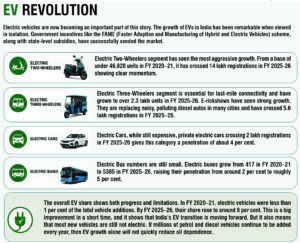
Despite the rapid expansion of renewable energy and electric mobility, India remains heavily reliant on imported oil. This dependency exposes the economy to international price volatility, increased freight costs and inflationary pressures whenever global supply chains are disrupted.

The Reality Check
The reason for our oil appetite is quite evident. As per our Envirocatalysts recent analysis, we identified the total number of registered vehicles in India jumped to over 3.07 crore in 2025-26 from about 1.83 crore in 2020-21. The trend shows that India’s transport system is still being shaped mainly by road-based mobility. Each year, more vehicles are being added increasing long-term fuel demand.

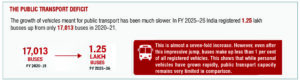
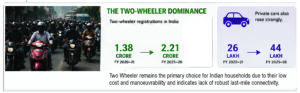
It is not just the total number of vehicles that matters, but the composition plays a key indicator in deciding the nation’s long term energy needs. According to the data, the recent surge is heavily skewed toward personal transport, which consumes fuel less efficiently than mass transport.
Need for Change
The prime minister’s call for measures towards reducing petrol and diesel use, carpooling more and using public transport becomes more important. It is not just a short-term response to global tension but projects a greater need for change. Once again, this highlights India’s fuel challenge is not only about where oil comes from, but also about how people travel every day. If this leads to better mobility planning, it could become an important turning point.
Jinitha Varghese is Program Manager at EnviroCatalysts and Sunil Dahiya is the Founder and Lead Analyst at EnviroCatalysts.

Latest

Kobelco launches three new excavators

The company unveiled the SK210, SK215LC and SK230XDLC at...

India, Poland eye doubling bilateral trade

Both leaders set the target of doubling bilateral trade...

Shift Towards Engineering Ownership

The recent U.S. suspension of several major Indian technology...

Navitas Secures Up to USD 20 Mln Growth Capital

The investment is a part of responsAbility’s Asia Climate...

Newsletter

Don't miss

Kobelco launches three new excavators

The company unveiled the SK210, SK215LC and SK230XDLC at...

India, Poland eye doubling bilateral trade

Both leaders set the target of doubling bilateral trade...

Shift Towards Engineering Ownership

The recent U.S. suspension of several major Indian technology...

Navitas Secures Up to USD 20 Mln Growth Capital

The investment is a part of responsAbility’s Asia Climate...

Balkrishna Industries, Pirelli in pact for tyre production

India is today one of the most attractive automotive...

Kobelco launches three new excavators

The company unveiled the SK210, SK215LC and SK230XDLC at its Sri City manufacturing facility. The new models combine Japanese technology with locally sourced components,...

India, Poland eye doubling bilateral trade

Both leaders set the target of doubling bilateral trade by 2030. Modi invited Polish companies to expand their investments and operations in India and to...

Shift Towards Engineering Ownership

The recent U.S. suspension of several major Indian technology companies, including TCS, Infosys, Wipro and HCLTech, from the Permanent Labor Certification process has renewed...