




Tamil Nadu raises as much revenue as its peers and spends more per citizen than almost all of them. The problem lies in the composition of that spending. An ever-larger share is pre-committed to salaries, pensions, interest and subsidies, leaving too little for the capital investment that actually builds the state. The challenge is productivity, not size.
Collapsing Tax Base
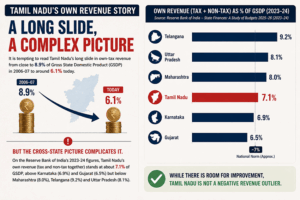
It is tempting to read Tamil Nadu’s long slide in own-tax revenue from close to 8.9 per cent of Gross State Domestic Product (GSDP) in 2006-07 to around 6.1 per cent today. But the cross-state picture complicates it. On the Reserve Bank of India’s 2023-24 figures, Tamil Nadu’s own revenue (tax and non-tax together) stands at about 7.1 per cent of GSDP, above Karnataka (6.9 per cent) and Gujarat (6.5 per cent) but below Maharashtra (8.0 per cent), Telangana (9.2 per cent) and Uttar Pradesh (8.1 per cent). While there is room for improvement, Tamil Nadu is not a negative revenue outlier.
This apparent contradiction is because Tamil Nadu began the period as an unusually high-effort state. Its strong pre-GST sales tax administration put it well above the roughly 7 per cent national norm and much of the fall reflects the GST transition, which stripped states of rate-setting autonomy and hit the erstwhile high-VAT states (like Tamil Nadu) hardest. The realistic headroom is one to two points of GSDP. Even one point is roughly Rs 27,000 crore a year!
Generous for today, thin for tomorrow
The resource pool is ordinary but spending is not. The running cost of services, consumed within the year and measured per citizen accounts to about Rs 40,500 per person on revenue account, the second highest, behind only Telangana and well ahead of Karnataka (Rs 35,500), Maharashtra (Rs 35,300) and Gujarat (Rs 26,700).
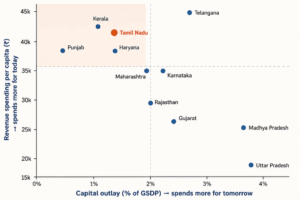
Set that against what will be spent for tomorrow. Capital outlay creates durable assets but its benefits accrue over many years. It is best measured against GSDP. On that measure Tamil Nadu invests just 1.5 percent of GSDP, among the lowest of the major states. The contrast with Gujarat is telling, the least spent per citizen on current account yet invests more for the future (2.3 percent of GSDP).
This is the paradox in a single picture. The question is, why does a state that spends so much, has so little left to build with? The answer lies in the rising wall of committed expenditure.
Power tariff subsidies – Rs 32,000 crore a year
Tamil Nadu now devotes around 77 per cent of its revenue receipts to committed and quasi-committed heads. When the borrowing ceiling also binds, the residual that gets squeezed is capital outlay. Tamil Nadu’s budget-to-actuals discipline is among the country’s best, but the arithmetic of a budget largely spent before it is allocated. Two forces have inflated that wall. The first is debt: with revenue lagging spending, outstanding liabilities have roughly doubled in under a decade, breaching the ceiling set by the state’s own Fiscal Responsibility Act. Because interest is itself a committed head, each year of borrowing tightens the next year’s squeeze.
The second, more dangerous force sits off the main balance sheet: the power sector. The distribution utility, TNPDCL, is technically insolvent and has accumulated losses of about Rs 1.19 lakh crore. It has a negative net worth and borrowings roughly nine times its equity. Keeping it afloat costs the state on the order of Rs 32,000 crore a year in tariff subsidies and loss-funding grants around 1.1 percent of GSDP. It is same as the entire health budget, and more than half of capital outlay. Loss-funding grants alone rose more than seventy-fold between FY18 and FY25. It is the clearest illustration of how an unreformed institution builds to being a ever growing burden.
Deepen the base
Where Tamil Nadu genuinely under-collects relative to its potential is land. It raises only about 0.7 percent of GSDP from stamps and registration, against Maharashtra’s 1.3 per cent. Not because rates are low (at 11 percent they are among India’s highest) but because guideline values run at perhaps 30 to 50 percent of the market. The fix is administrative:
• Revising guideline values annually toward the right tail of actual registered prices at micro-geography level.
• Linking property tax to those values through a transparent capital-value formula.
As honest valuation lifts the base, the stamp duty rate can be reduced to 7 per cent, easing transaction friction while staying revenue neutral. Punjab achieved a 35 percent collection uplift with exactly this method.
Two reforms could significantly strengthen Tamil Nadu’s finances. Simplifying agricultural-to-non-agricultural land conversion rules by removing duplicate approvals where master plans already regulate can reduce corruption, formalise revenue and accelerate urban growth, as seen in Andhra Pradesh and Telangana. At the same time, value-capture mechanisms can help the state recover gains from rising land prices around public infrastructure projects. On alcohol, with TASMAC already earning high margins, the focus may shift towards premium pricing and demand-led product availability rather than higher taxation alone.
Spending warrants a relook
Spending calls for testing every major head against equity (does it reach those who need it?), equality (does it treat citizens alike?) and efficiency (does it deliver value for each rupee?). Several heads warrant a relook.
Power subsidies are the clearest case. A large share of the Rs 32,000-crore power support flows to households well above the poverty line and to unmetered agricultural connections. This can be prevented through ration-card targeting or shifting agricultural supply to time-of-day tariffs paired with solarisation and replacing open-ended loss-funding with efficiency-linked viability-gap support that pays for measured operational improvement rather than simply underwriting losses.
Establishment and salary lock-ins deserve similar scrutiny. A growing share of the committed workforce is locked in through conventional, permanent hiring that commits the state to decades of salary and pension liability regardless of how service needs evolve. The point is not to cut wages but to ask whether every function must be delivered through a permanent establishment and if the long-run liability is justified against the immediate convenience.
The third issue is market crowding-out. In sectors like retail, transport, hospitality and services, private players already operate efficiently. When the government also enters these areas through subsidies or direct participation, it can reduce private investment without creating much additional benefit. A more efficient approach would be for the state to step back from sectors where markets work well and focus its resources on areas where private investment is insufficient.
It is clear that Tamil Nadu’s capital spending is weakened by delays, cost overruns and poor project execution, reducing the returns on public investment. With limited fiscal space, the state can no longer afford automatic spending. Every scheme, old or new must be evaluated strictly for cost-effectiveness and long-term public value before receiving funding.
The politics of the possible
Almost none of this analysis is new. It has been visible for years, including in the state’s own 2021 White Paper. Reforms hurt powerful groups immediately, while benefits come slowly. This asymmetry has held Tamil Nadu in high spending and low investment mode.
This is why a new government matters because the early phase of a fresh mandate offers the best chance to push difficult reforms before political pressures build. Tamil Nadu must act now, especially as fuel-tax revenues may decline with rising electric vehicle adoption. The state already has the institutional strength and policy groundwork. What it has lacked is the moment to spend political capital on hard things. A new term is that moment, and the cost of letting it pass will compound.