


SPREAD OVER 40 acres in southern Kolkata, the Uttarpara manufacturing complex of BSE-listed Titagarh Rail Systems Ltd (TRS), a leading manufacturer of railway vehicles, is transforming into a unique manufacturing hub, producing freight wagons, metro coaches and semi-high-speed trains, along with integrated propulsion systems, under one roof.
The Uttarpara facility is also a powerhouse of diversity, where about 1500 employees from 13 to 15 states come together to keep production rolling. This vibrant hub is not just building rail systems, it’s building national unity on the shop floor.
IRIS (International Railway Industry Standard)-certified and upgraded to meet Industry 4.0 standards, the facility is now fully equipped to produce modern aluminum and stainless-steel coaches for metro systems and India’s flagship Vande Bharat semi-high-speed trains. The plant will be manufacturing the 16-car Vande Bharat sleeper trainsets, with the first prototype expected by March 2026. The Uttarpara plant also caters to international demand, exporting traction systems to Europe—an uncommon feat for Indian OEMs.
The Uttarpara factory, part of Titagarh’s Passenger Rail Systems (PRS) division, is in the midst of a major capacity expansion. At present, the plant has an installed capacity to produce 300 coaches, 600 traction motors and 200 converters annually. To meet rising demand, this is being scaled up to 850 coaches, 2400 traction motors, and 1200 converters per year. The company has already invested Rs 1000 crore in this effort over the past few years. Supporting this expansion is Titagarh Advanced Manufacturing Systems (TAMS)—a smart, automated system designed to ensure smooth and efficient operations.
Over 75 per cent of the components used in manufacturing at Uttarpara plant are either sourced locally or produced within the country—reinforcing the Government’s Make in India and Atmanirbhar Bharat initiatives with every coach built.
While the technology plays a big role, it’s the people – engineers, inspectors and technicians, who really bring the place to life. They are literally building the future of Indian rail travel one coach at a time.
ROLLING INTO THE FUTURE
“In 2015, we seized a strategic opportunity by acquiring Firema, an Italian company renowned for its expertise in designing and manufacturing passenger trains, including metros, semi- and high-speed trains,” said Vijay Subramanian, CEO of Passenger Rolling Stock at TRS.
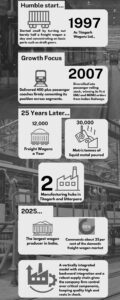 “This acquisition delivered two key advantages. First, it gave full ownership of proven technology for Electric Multiple Units (EMUs) and metro trains. Second, it enabled valuable knowledge transfer, allowing us to train our teams and build indigenous expertise in coach design and manufacturing within India,” he added.
At the time, the Indian passenger coach market was dominated by foreign players, and no Indian private company had access to comparable technology or production capabilities. “Make in India initiative played a pivotal role in enabling us to bridge that gap. It empowered us to aim higher and ultimately deliver on our ambitions,” stated Subramanian.
Before these policy changes, the market’s stringent eligibility criteria made it nearly impossible for Indian companies to compete. However, in 2019, the company’s persistence paid off when it secured its first major metro order for the Pune Metro project. The Pune Metro continues to stand out as the only aluminium-bodied metro coach in India.
CAPACITY EXPANSION UNDER ONE ROOF
The Uttarpara facility remains the only one in India capable of manufacturing both aluminium and stainless-steel coaches. While stainless steel is still the industry standard domestically, aluminium is crucial for high-speed and semi-high-speed trains, especially in international markets. “We are positioning ourselves to meet that global demand as the industry evolves,” he added.
Recently, TRS and its associate company, Titagarh Firema S.p.A., received approval from Maharashtra Metro Rail Corporation Limited for the supply of 12 additional trainsets. This covers the design, manufacture, supply, testing and commissioning of passenger rolling stock, as well as the training of personnel for the Pune Metro Rail Project. The total value is about Rs 431 crore.
The company, the first private manufacture of passenger rolling stock presents a strong vision for the future of passenger rail systems, with a strategic focus on expanding its rolling stock capacity. It has ambitious plans to increase the capacity to 850 coaches by FY27, up from 300 now, and further to 1200 per annum by FY28. This growth trajectory is supported by a significant increase in the company’s order book, which has nearly doubled from Rs 3481 crore in FY21 to a projected Rs 6850 crore in FY25.
TAILWINDS AHEAD
The company anticipates robust growth in the passenger rail segment, buoyed by the Indian government’s large-scale infrastructure push. A sweeping transformation of the passenger rail system is expected over the next four to five years as part of a strategy to eliminate waitlists and enhance national connectivity. Central to this initiative is the introduction of 3000 new trains, alongside the deployment of about 450 Vande Bharat trains aimed at modernising and increasing the network’s capacity.
 At the heart of this transformation lies the Vande Bharat project, with the government planning to launch 400 trains under this banner. The projected market opportunity for these trains is estimated at about Rs 60,000 crore, with another Rs.65,000 crore expected from other variants. Reinforcing this push, the union budget 2025–26 includes provisions for 200 additional Vande Bharat trains, 100 Amrit Bharat trains, 50 Namo Bharat rapid rail systems, and 17,500 general non-air-conditioned coaches. These initiatives are designed to redefine rail travel for the masses over the next two to three years.
Parallel efforts are underway to expand the metro rail network, with the government aiming to bring metro services to 50 cities. This involves more than doubling the existing network to 1700 kilometers and procuring around 5000 new metro rail coaches. To address the needs of smaller cities with lower traffic volumes, the government also plans to introduce Metro Lite and Metro Neo systems that are cost-effective alternatives to conventional metro lines.
DESIGNING TO DELIVER
TRS has planned a comprehensive strategic investment and production enhancement plan, focusing on two core areas: metro and passenger coaches, and propulsion strategy.
Under the metro and passenger coaches’ growth plan, the company is currently operating under a stabilised production capacity of 25 coaches per month. This phase meets the demands of existing contracts and represents the initial milestone in PRS execution.
Looking ahead, the company aims to scale up production capacity to 72 coaches per month by 2027, with a ramp-up during the peak execution phase of key projects such as Vande Bharat, Surat & Ahmedabad Metro, Bangalore Metro, and other contracts. This Phase 2 expansion will include fully indigenous manufacturing of stainless-steel coaches under one roof.
In parallel, Titagarh is implementing a phased strategy for backward integration to strengthen its manufacturing ecosystem. In Phase 1, which is nearing completion, the company is setting up in-house production capacities for 150 traction motors, 16 converters, and complete propulsion systems for EMU (Electric multiple unit) and MEMU (Mainline Electric multiple unit) units. Phase 2 will see an expansion to 200 which operate on mainlines to cover distances more than suburban sections, traction motors and 32 converters per month, along with the development of propulsion systems specifically designed for metro and semi-high-speed trains. In Phase 3, the focus will shift to enhancing flexibility through fungible systems that enable cross-platform usage, while achieving a monthly output of 200 motors, 100 converters and continuing advancements in propulsion technologies for both metro and semi-high-speed train segments.
The company has identified several strategic targets for the current fiscal. These include the prototype and series dispatch of metro coaches for Surat and Ahmedabad, dispatches for Vande Bharat and EMU/MEMU propulsion systems, and the series production of Bangalore Metro coaches. These initiatives underscore TRS’ role in driving the modernisation and expansion of India’s urban and intercity rail infrastructure.
STRONG IN-HOUSE R&D PUSH
The company’s engineering and R&D ecosystem spans five centers—two in Italy and three in India (Kolkata, Hyderabad, and Bengaluru). Each location specialises in key subsystems: carbody and integration (Kolkata), HVAC and underframe systems (Hyderabad), and propulsion systems (Bengaluru). Collectively, over 130 engineers are working on current and future platforms, including the aluminium–stainless steel hybrid Vande Bharat sleeper trains.
TRS, along with its consortium partner BHEL, is building 80 sleeper trainsets as part of a turnkey build-own-maintain contract. This effort is independent from parallel projects by TMH and BEML, with TRS responsible for complete, end-to-end manufacturing, rather than just component supply. The first prototype is scheduled for delivery by March–April 2026.
“We are proud to be at the forefront of designing and manufacturing 80 Vande Bharat sleeper trains awarded to the BHEL–Titagarh Rail Systems consortium under a build-own-maintain model,” said Veerakumar Sivasubramanian, Executive Vice President (Operations and Propulsions).
“Unlike companies that supply only select components, we are responsible for the complete lifecycle—from end-to-end design and manufacturing to long-term maintenance. This sets us apart from the competition, which has traditionally focused on providing propulsion systems. In our case, we are constructing the entire trainset from the ground up,” he added. The first prototype is scheduled for delivery by March–April 2026.
Meanwhile, the company is also scaling production for Delhi Metro and recently encountered delays on the Bangalore Metro project. These were primarily due to visa issues affecting foreign engineers needed for commissioning imported equipment, along with some supply chain disruptions. As with most complex rail projects, Sivasubramanian noted that the first few units often require engineering revisions—13 so far in this case—before full-scale production stabilises.
Currently, TRS is targeting the delivery of two trainsets per month. However, each set undergoes extensive testing lasting up to 100 days and covering over 500 checkpoints before final approval. After the revised prototype rolled out in May, another is expected by mid-next month.
ROBUST ORDER BOOK
The company is received more than Rs 1200 crore worth of new orders FY25 across various business segments. These include approximately Rs 900 crore in orders for freight rolling stock and Rs 303 crore for propulsion systems. The company’s order book now includes around 11,500 wagons and 1,583 Metro and Vande Bharat coaches.
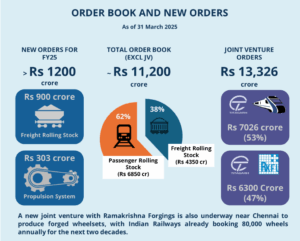 The total order book for the company (excluding joint ventures) stood at approximately Rs 11,200 crore. With orders coming in from the passenger rolling stock segment, the order book composition has also diversified—of the total orders, 62 per cent (Rs 6850 crore) pertains to passenger rolling stock, while 38 per cent (Rs4350 crore) relates to freight rolling stock. Additionally, the company holds a share in joint venture orders amounting to Rs 13,326 crore. This includes Rs 6300 crore (47%) from the joint venture with Ramakrishna Forgings Ltd. for wheels, and Rs 7,026 crore (53%) from the Vande Bharat project with BHEL. A new joint venture with Ramakrishna Forgings is also underway near Chennai to produce forged wheelsets, with Indian Railways already booking 80,000 wheels annually for the next two decades.
The growth momentum in the freight rolling stock segment is also expected to remain strong, supported by several favorable developments. India’s railway freight sector is on track for substantial expansion by FY30, with the share of freight traffic carried by rail projected to rise from 27 per cent to 45 per cent. This growth will be underpinned by an increase in annual freight volumes to 3600 million tonnes by FY31.
A significant catalyst for this surge is the development of three major railway economic corridors under the PM Gati Shakti initiative. Specifically, the East-Coast, East-West, and North-South Sub-corridors together span more than 4200 km. These corridors are anticipated to drive a major uplift in freight movement and infrastructure capacity. Furthermore, the annual freight target is set to climb from about 3 lakh to 5.4 lakh in the near term.
These industry dynamics translate into substantial opportunities for TRS. Indian Railways is expected to procure 1 to 1.2 lakh incremental wagons, translating into a sizable market opportunity valued between Rs 35,000 and Rs 40,000 crore. The growing demand will stem from both new freight needs and the replacement of aging wagons that have reached their 30- to 35-year economic life. With the annual freight target poised to increase by nearly 80 per cent, demand for freight wagons is set to rise in tandem, further reinforcing TRSL’s growth prospects.
UPCOMING BUSINESS ORDERS
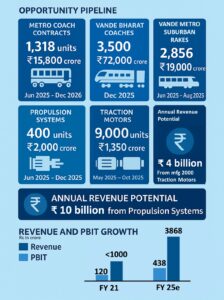
TRS sees a robust opportunity pipeline across multiple high-value rail infrastructure segments. The company is eyeing significant opportunities in metro coach contracts, with around 1318 units valued at approximately Rs 15,800 crore expected to be tendered between June 2025 and December 2026. A major growth area is the Vande Bharat coach segment (including both aluminium and stainless steel variants), with an estimated 3500 units valued at Rs 72,000 crore slated for tendering in December 2025.
Additionally, the company anticipates tenders for about 2856 Vande Metro suburban rakes, representing a potential value of Rs 19,000 crore, expected between June 2025 and August 2025. In the propulsion systems segment, roughly 400 units with an estimated value of Rs 2000 crore are expected to come up for tender from June 2025 through December 2025. Furthermore, the company is targeting the traction motors segment, with approximately 9000 units valued at around Rs 1350 crore, with tendering likely in his fiscal .
With new platforms ready and approvals in place for its traction motors and EMU designs, TRS aims to become a key player not just in India, but on the global stage.
“Titagarh has significantly ramped up its production of traction motors, currently achieving a run rate of 100 units per month. The company aims to further increase this to about 125–150 units monthly in the near future. Over the medium term, management anticipates the capability to manufacture around 2000 traction motors annually, which could generate revenue of about Rs 4 billion. In addition, it expects to earn around Rs 10 billion in annual revenues from propulsion systems used in EMU, MEMU and Vande Bharat trains. Altogether, this positions the company to potentially generate approximately Rs 15 billion in annual revenue from the propulsion systems segment alone,” according to analysts at Nuvama Research.
The company has demonstrated significant financial growth over the years. Its revenue has risen from less than Rs 1000 crore in FY21 to an estimated Rs 3866 crore in FY25, while PBIT (Profit Before Interest and Tax) has improved from Rs 120 crore to Rs 439 crore over the same period. It posted a net profit of Rs.303 crore in Fy25. While freight rail systems account for the major portion of the topline, the revenue mix is expected to shift in the coming years in view of the strong outlook in the passenger business.
TRS has renewed its strategic focus on the shipbuilding segment, signaling a broader diversification of its business portfolio beyond rail systems. This revival marks a return to a sector where the company has prior experience and technical capabilities, and aligns with national priorities around strengthening indigenous shipbuilding and maritime infrastructure.
In parallel, it has also launched a new vertical dedicated to Safety and Signalling Systems (SSS), an area critical to the modernisation and automation of rail networks. The company has already begun actively participating in tenders and bidding for contracts in this domain.
TRS is evolving from a traditional wagon manufacturer into an engineering-driven enterprise, positioning itself to seize opportunities across multiple domains within the rail ecosystem. With a vision to be recognised as a company that builds “for the world from India,” TRS is actively reshaping its identity in the global rail mobility space. The management remains focused on creating a sustainable growth model by reinforcing the value chain through backward integration and expanding its footprint through strategic alliances and partnerships.