


The leading tyre maker had earlier projected 7–8 per cent growth for the industry in this fiscal. “I will say that 8–9% growth is very much achievable, and there will definitely be a surge in the auto industry. Particularly in consumer-facing segments—passenger car radials, two- and three-wheelers—demand will rise. This is not only due to GST sentiment, but also because of overall positive economic sentiment, with a government-led infrastructure push, a good monsoon, and a rural demand uptick, as also seen in FMCG,” Anshuman Singhania, Managing Director of the company, told reporters at the company’s tyre factory near Chennai, which accounts for a little over one-fourth of the company’s revenues.
He said the company has robust plans to tackle rural demand, especially in “white spaces” where it is not yet present—mainly towns with less than 1 lakh population across India.
“We have repositioned our product line and introduced a very premium product in terms of performance. We started our activities even before the season began, and our OEM footprint has seen a positive response. With better monsoons, rural pickup, and GST benefits, the future looks very bright,” Singhania added.
Sanjeev Agarwal, Chief Financial Officer of the company, pointed out that the CV industry, where the company enjoys a strong presence, will benefit the most from GST for two reasons. First, total available freight will go up due to rising consumption and demand. Second, with falling interest rates, capacity utilization will improve, and new capacity will be added to CV fleets.
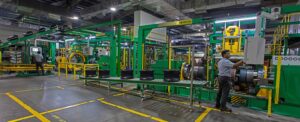
Discussing Chennai plant operations, Singhania said the factory accounted for about 26% of its production and revenue. “It holds a very significant position in our portfolio. Here, we make many premium products. JK Tyre has been investing heavily in upgrading and premiumising our product range. With the latest equipment and continuous investments, we are able to produce high-quality, value-added products for both domestic and export markets,” he added.
The company has invested more than ₹2,600 crore in the Chennai factory, which has a capacity of 350 tonnes a day, for producing passenger car radial and truck and bus radial tyres.
The Chennai plant, which has been built on a 103-acre site, has produced a unique range of tyres, made with nearly 80 per cent sustainable and recycled materials. “These tyres undergo up to 50,000 km of fleet testing before release,” he said.
Replying on the movement of raw material prices, he said material costs rose by about 10 per cent last year, but JK Tyre absorbed much of it, passing on only 4.5 per cent to customers.
Exports make up 12–15 per cent of revenues, with the US accounting for 3 per cent of the total exports.
Singhania also said the company is focusing on smart and connected tyre technologies, with TPMS and embedded sensors gaining strong traction across two- and three-wheelers, passenger cars, and commercial vehicles. The company noted that low tyre inflation is a major cause of accidents, and sensor alerts—now being integrated directly into tyres—help improve safety and reduce risks. These innovations also provide valuable data for R&D, enabling performance improvements. Customer feedback, including cases where alerts prevented accidents, shows growing adoption, especially among new-generation consumers.