

According to CRISIL Ratings, the states’ revenue is expected to grow by 7–9% year-on-year to approximately ₹40 lakh crore, slightly higher than the 6.6% growth recorded in FY25 but still below the decade-long average of around 10%.
The anticipated improvement in revenue growth will be primarily supported by steady Goods and Services Tax (GST) collections and higher tax devolutions from the central government. Additionally, grants from the Centre are expected to recover after a decline in the previous fiscal.
States generate revenue through two broad streams: the states’ own revenue (SOR) and central transfers. SOR comprises the state’s own tax revenue (SOTR), which includes GST, liquor tax, and petroleum tax. Transfers from the Centre consist of tax devolutions and grants.
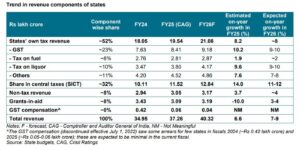
SOTR is projected to grow around 8% in FY26, driven primarily by GST and liquor taxes, while petroleum tax is expected to see modest growth.
“GST collections remain the driver for states’ own taxes, with on-year growth projected at 9–10% for this fiscal, marginally lower than the last. The GST collections should sustain, considering an expected nominal GDP growth of approximately 9%. While better tax compliance and a continued shift from the unorganised to the organised sectors will support GST revenue, subdued domestic consumption and inflation pose downside risks,” said,” said Anuj Sethi, Senior Director, CRISIL Ratings.
Liquor tax revenue is expected to grow at a stable rate of 9–10%, comparable to the 9.6% growth recorded in the previous year. This growth will be led by a 5–6% increase in volume consumption and higher excise duties imposed by states.
Sales tax on petroleum products is expected to grow modestly at around 2%, in line with the last fiscal year. This will be largely volume-driven, as the tax structure on petroleum remains unchanged.
Despite the moderate pace of growth in states’ own taxes, revenue will continue to benefit significantly from tax devolutions from the Centre. “Tax devolutions from the central government are expected to rise 11–12% this fiscal after a strong growth of nearly 14% last fiscal,” said Aditya Jhaver, Director, CRISIL Ratings. “Rising gross tax collections, supported by growth in income tax and GST collections, remain a key driver.”
In a positive development, grants from the Centre—which had declined by about 10% in the last fiscal year due to lower capital expenditure and reduced transfers under centrally sponsored schemes (CSS)—are expected to recover and grow by 3–4% in FY26. This recovery will be driven by higher allocations toward CSS and Finance Commission grants to urban and rural local bodies, as indicated in both central and state government budget estimates for FY26.
The revenue projections assume India’s nominal GDP will grow at around 9% this fiscal. However, CRISIL cautions that global uncertainties, shifting domestic consumption trends, and inflation could impact revenue outcomes. Conversely, stronger-than-expected tax buoyancy and continued central support could further enhance state revenues.
To ensure long-term fiscal sustainability, experts recommend that states intensify efforts to broaden their own revenue base and improve tax collection efficiency.

