


Fertiliser subsidy since 2022 put at ₹6.77 lakh crore

The Government of India has disbursed a total of ₹6.76 lakh crore in fertilizer subsidies between 2022-23 and 2025-26 (as on July 21, 2025) under the Direct Benefit Transfer (DBT) in Fertilizers system, according to information provided in the Lok Sabha by Union Minister of State for Chemicals and Fertilizers, Anupriya Patel.

Listen to this article

During the period, the annual subsidy disbursement stood at ₹2,54,798.88 crore in 2022–23, ₹1,95,420.51 crore in 2023–24, ₹1,77,129.50 crore in 2024–25, and ₹49,329.88 crore in 2025–26 (up to July 21), bringing the cumulative total to ₹6,76,678.77 crore, according to an official statement.

Under the DBT system, 100% subsidy on various grades of fertilizers is released directly to fertilizer companies based on actual sales to farmers. These sales are authenticated through Aadhaar-enabled Point-of-Sale (PoS) devices installed at every retail outlet, ensuring transparency and efficiency in subsidy disbursement.

For urea, the government supplies it at a statutorily notified Maximum Retail Price (MRP) of ₹242 per 45 kg bag (excluding neem coating and applicable taxes). The difference between the delivered cost and the net market realisation is reimbursed to the manufacturer or importer as a subsidy.
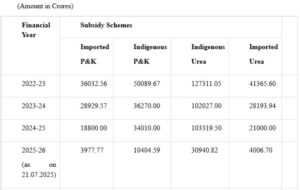

In the case of Phosphatic and Potassic (P&K) fertilizers, the government has implemented the Nutrient-Based Subsidy (NBS) Policy since April 1, 2010. Under this policy, a fixed subsidy amount is provided based on the nutrient content, and the MRP is determined by fertilizer companies in line with market dynamics while being monitored by the government. This ensures affordability for farmers while maintaining transparency and sustainability in fertilizer distribution.

The DBT system allows farmers — including small, medium, and large-scale cultivators — to access fertilizers at subsidised rates on a no-denial basis. Any Aadhaar-authenticated buyer can purchase fertilizer, ensuring wide and equitable access, especially for poor and marginal farmers.

Latest

US grants 30-day waiver to India to buy Russian Oil: Treasury Secretary Scott Bessent

US Treasury Secretary Scott Bessent said the Treasury Department...

West Asia Conflict: A look at potential sectoral impact

Energy: A majority of energy is transported through the Strait...

Somany Ceramics says supplier restricts gas supply, amid Middle East conflict

Accordingly, SGL has informed that the Daily Contracted Quantity...

GAIL mulls supply cuts on customers, amid Force Majeure notices

GAIL said its long-term suppliers, Petronet LNG Ltd, has...

Newsletter

Don't miss

US grants 30-day waiver to India to buy Russian Oil: Treasury Secretary Scott Bessent

US Treasury Secretary Scott Bessent said the Treasury Department...

West Asia Conflict: A look at potential sectoral impact

Energy: A majority of energy is transported through the Strait...

Somany Ceramics says supplier restricts gas supply, amid Middle East conflict

Accordingly, SGL has informed that the Daily Contracted Quantity...

GAIL mulls supply cuts on customers, amid Force Majeure notices

GAIL said its long-term suppliers, Petronet LNG Ltd, has...

US Trade court orders tariff refunds: report

"All importers of record whose entries were subject to...

US grants 30-day waiver to India to buy Russian Oil: Treasury Secretary Scott Bessent

US Treasury Secretary Scott Bessent said the Treasury Department is issuing a temporary 30-day waiver to allow Indian refiners to purchase Russian oil, amid...

West Asia Conflict: A look at potential sectoral impact

Energy: A majority of energy is transported through the Strait of Hormuz, located between Oman and Iran and the vital artery for global energy trade,...

Somany Ceramics says supplier restricts gas supply, amid Middle East conflict

Accordingly, SGL has informed that the Daily Contracted Quantity of gas supply shall be provisionally restricted to 50 per cent of the contracted quantity...