



Exports, which contributed around $16 billion or 27% of the sector’s revenue last fiscal, will be hardest hit. The US accounted for one-third of those exports, but its share is expected to fall to 20-25% this fiscal.
“If the tariffs hold, RMG exports to the US will see a sharp decline,” said Manish Gupta, Deputy Chief Rating Officer, Crisil Ratings. He noted that exports to the US had grown 14% in the first quarter, but volumes are likely to shrink sharply once the higher tariffs take effect.
To mitigate the impact, exporters are expected to shift focus towards other major markets such as the European Union, United Kingdom and United Arab Emirates, which together make up 45% of India’s exports. The recently signed Free Trade Agreement with the UK could also provide some relief from the end of this fiscal.
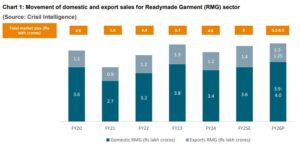
On the domestic front, which accounts for three-fourths of the sector’s revenue, steady growth of 8-10% is expected this year, driven by economic expansion, interest rate cuts and lower taxes. “This will cushion the tariff blow and support overall sector growth, albeit at a slower pace than last fiscal,” said Gautam Shahi, Director, Crisil Ratings.
However, profitability is set to take a hit. Exporters heavily dependent on the US market could see margins contract by 300-500 basis points, while industry-wide profitability may dip 50-150 bps. With domestic oversupply also a risk, interest coverage ratios are projected to decline to 3.5-3.7 times this fiscal from 3.9 times last year, while leverage could rise to 3-3.1 times from 2.78 times.
Crisil noted that if tariffs are rolled back to 25%, India could regain its competitive edge, thanks to its strong presence in value-added garments. But until then, higher US duties, inflation-driven demand weakness, and potential spikes in cotton prices remain key risks for the sector.

