


Shradha Suri Marwah, President of ACMA and CMD of Subros, stated that the Indian auto component sector remained a key pillar of the country’s manufacturing strength. She observed that FY25 had been another significant year for the industry, with growth driven by strong domestic demand, increasing exports, and greater value addition.
The industry reported a positive trade balance, with exports rising 8% to $22.9 billion, while imports grew 7.3% to $22.4 billion, resulting in a trade surplus of $453 million—an improvement over the previous fiscal’s surplus of $300 million.
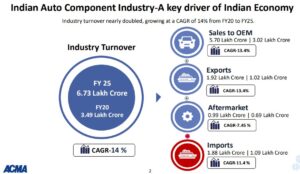 Vinnie Mehta, Director General of ACMA, stated that all key segments—including OEM sales, exports, and the aftermarket—had shown positive trends in FY25, which marked a 9.6% increase over the previous fiscal year. He highlighted that the trade surplus of $453 million reflected India’s increasing manufacturing competitiveness and successful localization efforts.
OEM sales and domestic growth
Sales to original equipment manufacturers (OEMs) in the domestic market reached ₹5.70 lakh crore, up 10% year-on-year. This growth was driven by an 8% increase in vehicle production and a rising preference for high-value, performance-oriented vehicles, which spurred demand for advanced components.
Aftermarket expansion
The aftermarket segment also showed steady progress, growing by 6% to ₹99,948 crore ($11.8 billion). This growth was supported by an expanding used vehicle base, the formalisation of the repair ecosystem, and increasing rural demand aided by e-commerce penetration.
“As India advances towards new-age mobility, the auto component industry is investing in technology, value addition, and localization to stay globally competitive,” Marwah said.
Challenges and outlook
This fiscal witnessed broad-based growth and recovery across segments. While the two-wheeler segment demonstrated robust growth, the passenger vehicle and commercial vehicle segments experienced steady, albeit moderate, momentum. On the exports front, ongoing geopolitical developments led to supply chain disruptions, she said.
Despite strong performance, the industry continues to face headwinds, including supply chain disruptions caused by geopolitical instability and the limited availability of rare-earth magnets—a key input in electric mobility solutions.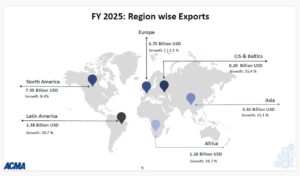
“The limited availability of rare-earth magnets remains a concern, underscoring the need for a national strategy on critical materials to secure the future of EV and mobility manufacturing in India,” she added.
Exports and imports
Region-wise, North America accounted for 32% of India’s component exports, growing 8.4%, while exports to Asia (26% share) surged by 15.1%. However, exports to Europe (29.5% share) dipped slightly by 2.1%. Major export categories included drivetrain components, engine parts, suspension systems, braking units, and body and chassis elements.
On the import front, Asia continued to dominate, accounting for two-thirds of the total. The 7.3% rise in imports was attributed to the demand for specialized components and technologies.