

According to the report, Kisan Drones distributed under the scheme are capable of spraying one acre of farmland in just 7–8 minutes, with a flight time ranging from 5 to 20 minutes per battery, depending on the manufacturer. Each drone package includes one standard battery and four additional sets, enabling extended operational efficiency in the field.
However, the study also flagged critical logistical challenges. In cases where utility vehicles were not provided along with the drones, 42.68% of Drone Didis reported transportation-related issues, with the southern region of India being the most affected (78.82%). Additionally, 68.66% of SHG members found it expensive to hire transport vehicles for drone movement.
In response, the government has introduced a provision under the Sub-Mission on Agricultural Mechanization (SMAM) to provide 80% financial assistance for the purchase of multi-utility vehicles by eligible SHGs, easing drone mobility and operational constraints.
The study also indicates that SHGs were primarily engaged in agriculture and allied activities, and the drones provided to them have expanded their niche into modern agricultural practices through drone technology, enhancing their efficiency and productivity. Overall, the adoption of drones has diversified SHG activities, improved agricultural practices, and increased income opportunities for women in rural communities.
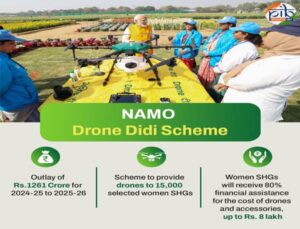
The Namo Drone Didi Scheme, a Central Sector initiative, was launched with a total outlay of ₹1,261 crore for the period 2023–24 to 2025–26. The scheme aims to integrate advanced drone technology into Indian agriculture while empowering women Self Help Groups (SHGs) as drone service providers. Each selected SHG receives a drone package with pilot training for one member and assistant training for another, along with 80% Central Financial Assistance (CFA)—up to ₹8 lakh—for procurement.
As of FY24, 1,094 drones were distributed to women-led SHGs by Lead Fertilizer Companies (LFCs) using internal resources, including 500 drones under the Namo Drone Didi Scheme. Members of these SHGs have received training at DGCA-authorized Remote Pilot Training Organizations (RPTOs).
In that year, the drones were distributed across 22 states, with an equal number of 1,094 SHG members receiving drone pilot training. Karnataka led the initiative with 145 drones and trained members, followed by Uttar Pradesh (128), Andhra Pradesh (108), and Haryana (102). Other key states included Madhya Pradesh (89), Telangana (81), Maharashtra (60), Gujarat (58), Punjab (57), and Kerala (51).
Smaller but significant distributions were made in Tamil Nadu (44), Rajasthan (40), Bihar (32), and Assam (28). States like Odisha (16), Chhattisgarh (15), Jharkhand (15), and West Bengal (15) also benefitted. Meanwhile, Goa (1), Uttarakhand (3), Himachal Pradesh (4), and Jammu & Kashmir (2) received limited allocations, reflecting varied implementation scales.

