


Fertiliser subsidy since 2022 put at ₹6.77 lakh crore

The Government of India has disbursed a total of ₹6.76 lakh crore in fertilizer subsidies between 2022-23 and 2025-26 (as on July 21, 2025) under the Direct Benefit Transfer (DBT) in Fertilizers system, according to information provided in the Lok Sabha by Union Minister of State for Chemicals and Fertilizers, Anupriya Patel.

Listen to this article

During the period, the annual subsidy disbursement stood at ₹2,54,798.88 crore in 2022–23, ₹1,95,420.51 crore in 2023–24, ₹1,77,129.50 crore in 2024–25, and ₹49,329.88 crore in 2025–26 (up to July 21), bringing the cumulative total to ₹6,76,678.77 crore, according to an official statement.

Under the DBT system, 100% subsidy on various grades of fertilizers is released directly to fertilizer companies based on actual sales to farmers. These sales are authenticated through Aadhaar-enabled Point-of-Sale (PoS) devices installed at every retail outlet, ensuring transparency and efficiency in subsidy disbursement.

For urea, the government supplies it at a statutorily notified Maximum Retail Price (MRP) of ₹242 per 45 kg bag (excluding neem coating and applicable taxes). The difference between the delivered cost and the net market realisation is reimbursed to the manufacturer or importer as a subsidy.
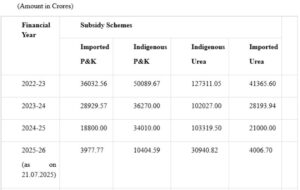

In the case of Phosphatic and Potassic (P&K) fertilizers, the government has implemented the Nutrient-Based Subsidy (NBS) Policy since April 1, 2010. Under this policy, a fixed subsidy amount is provided based on the nutrient content, and the MRP is determined by fertilizer companies in line with market dynamics while being monitored by the government. This ensures affordability for farmers while maintaining transparency and sustainability in fertilizer distribution.

The DBT system allows farmers — including small, medium, and large-scale cultivators — to access fertilizers at subsidised rates on a no-denial basis. Any Aadhaar-authenticated buyer can purchase fertilizer, ensuring wide and equitable access, especially for poor and marginal farmers.

Latest

Kobelco launches three new excavators

The company unveiled the SK210, SK215LC and SK230XDLC at...

India, Poland eye doubling bilateral trade

Both leaders set the target of doubling bilateral trade...

Shift Towards Engineering Ownership

The recent U.S. suspension of several major Indian technology...

Navitas Secures Up to USD 20 Mln Growth Capital

The investment is a part of responsAbility’s Asia Climate...

Newsletter

Don't miss

Kobelco launches three new excavators

The company unveiled the SK210, SK215LC and SK230XDLC at...

India, Poland eye doubling bilateral trade

Both leaders set the target of doubling bilateral trade...

Shift Towards Engineering Ownership

The recent U.S. suspension of several major Indian technology...

Navitas Secures Up to USD 20 Mln Growth Capital

The investment is a part of responsAbility’s Asia Climate...

Balkrishna Industries, Pirelli in pact for tyre production

India is today one of the most attractive automotive...

Kobelco launches three new excavators

The company unveiled the SK210, SK215LC and SK230XDLC at its Sri City manufacturing facility. The new models combine Japanese technology with locally sourced components,...

India, Poland eye doubling bilateral trade

Both leaders set the target of doubling bilateral trade by 2030. Modi invited Polish companies to expand their investments and operations in India and to...

Shift Towards Engineering Ownership

The recent U.S. suspension of several major Indian technology companies, including TCS, Infosys, Wipro and HCLTech, from the Permanent Labor Certification process has renewed...