


Next Industrial Surge

Tamil Nadu has established a diverse base in auto, engineering, textiles, leather, petrochemicals and electronics ensuring long-term resilience and export capability. Now, future policy must decentralise the high-quality industrialisation to alleviate the congestion, land scarcity and logistical stress caused by the concentration in the northern belt and Chennai. Finance Minister Nirmala Sitharaman stated that the next phase of GCC growth in India would be more geographically diverse, with Tier-II and Tier-III cities becoming significant hubs of innovation and balanced regional development at the CII GCC Business Summit. She made it clear that cities like Tiruchirappalli could provide innovations in AI, engineering design and product development and that the next GCC phase cannot be restricted to a small number of major cities.

Listen to this article

Recommended policy model

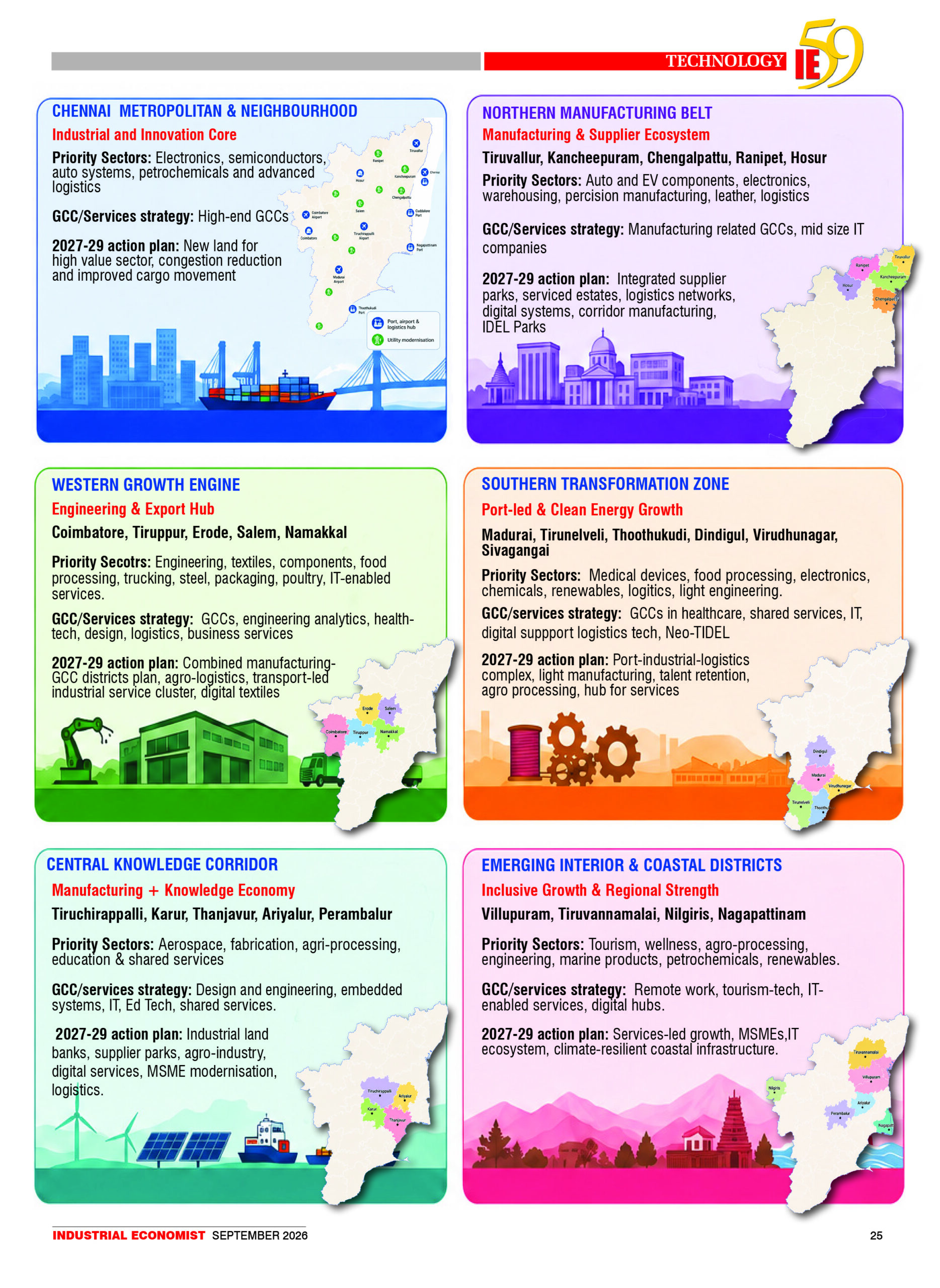
To deepen regional development, Tamil Nadu could adopt a multimodal transformation approach anchored on six strategic pillars.

⃝Corridor-led industrialisation: Develop limited number of industrial corridors with clear sectoral specialisation, trunk infrastructure and logistics linkages, rather than scattering projects across unconnected sites.

⃝Tier-II and Tier-III urban industrialisation: With Coimbatore, Tiruchirappalli, Madurai, Salem, Hosur, Tirunelveli, Erode, Thanjavur, Tiruppur and Thoothukudi as anchor cities for regionally distributed growth, combining manufacturing parks, GCC spaces, skill centres and logistics nodes.

⃝Multimodal freight integration: Align industrial policy with the Logistics Policy 2023 by developing multimodal logistics parks, warehousing clusters, private freight terminals, rail sidings and better last-mile roads to industrial and agricultural clusters.

⃝Manufacturing-plus-GCC ecosystems: Encourage firms to co-locate production with design, engineering, testing, analytics, software and back-office functions in sectors such as semiconductors, automotive electronics, industrial automation, medical devices and renewable energy equipment.

⃝Infrastructure bundling: Make industrial approvals conditional on the readiness of power, water, internal roads, drainage, waste treatment, worker mobility, housing and digital systems.

⃝Outcome-based incentives: Shift to incentives based on jobs, exports, local sourcing, energy efficiency, R&D and location in underdeveloped districts, instead of relying mainly on up-front capital support.

These pillars can be translated into a district-specific implementation framework, that outlines workable interventions that the government can implement between 2027 and 2030.
Latest

A Law On Confidence, Not Just Concessions

It is worth pausing about why an ordinance was...

Easing Business, Enabling Growth

The MSME sector is the backbone of India’s economy....

Policy Stability Continues in TN

How was your experience setting up a manufacturing facility...

The Art Of Giving Up

In the early 90s, Enfield India, the maker of...

Newsletter

Don't miss

A Law On Confidence, Not Just Concessions

It is worth pausing about why an ordinance was...

Easing Business, Enabling Growth

The MSME sector is the backbone of India’s economy....

Policy Stability Continues in TN

How was your experience setting up a manufacturing facility...

The Art Of Giving Up

In the early 90s, Enfield India, the maker of...

A Story Around Every Corner…

More than anything, I was drawn to the hospitality...

A Law On Confidence, Not Just Concessions

It is worth pausing about why an ordinance was the route chosen. It shows the closely watching foreign holders of Indian bonds that the...

Easing Business, Enabling Growth

The MSME sector is the backbone of India’s economy. According to the Economic Survey 2025-26, MSMEs account for 31.1 per cent of GDP, 35.4...

Policy Stability Continues in TN

How was your experience setting up a manufacturing facility in Tamil Nadu? We wanted our factory up and running as per our drawing board plans....