



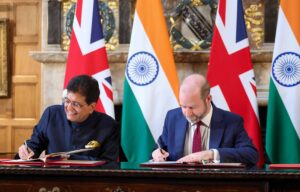
The agreement was signed in London by Commerce and Industry Minister Piyush Goyal and the UK Secretary of State for Business and Trade Jonathan Reynolds in the presence of Prime Minister Narendra Modi and the UK Prime Minister Keir Starmer, according to an official statement.
“This agreement is more than just an economic partnership; it is a blueprint for shared prosperity. On the one hand, it paves the way for enhanced market access in the UK for Indian textiles, footwear, gems and jewellery, seafood, and engineering goods. On the other, it will also unlock new opportunities for India’s agricultural produce and processed food industry. Above all, this agreement will be especially beneficial for India’s youth, farmers, fishermen and the MSME sector,” said Prime Minister Modi in his joint address with the UK Prime Minister.
The UK-made products such as medical devices and aerospace components would become more accessible and affordable for Indian consumers and industries, he added.
Wide-ranging benefits
CETA also includes wide-ranging commitments in services, giving Indian IT, legal, financial, education and consulting firms greater access to the UK market. The agreement streamlines visa and mobility pathways for Indian professionals, including contractual service providers, intra-corporate transferees, chefs, yoga instructors and musicians—facilitating smoother talent movement between the two countries.
A major breakthrough under the pact is the Double Contribution Convention, which will exempt Indian professionals and their employers from social security payments in the UK for up to three years—enhancing workers’ take-home pay and reducing operating costs for Indian companies.
Sustainable trade
Minister Goyal credited Prime Minister Modi’s leadership for making the agreement possible, saying it reflected a balanced and forward-looking approach that was aimed it safeguarding India’s core interests while accelerating its global trade ambitions. The agreement was also designed to promote inclusive and sustainable trade with benefits for start-ups, farmers, fishermen, young entrepreneurs and the MSME sector, he said. The pact was expected to deepen economic ties and generate employment in both nations in the years ahead, he added.
As soon as the treaty comes into force, 64% of tariff lines will be eligible for tariff-free imports into India, covering £1.9 billion of current UK exports. After a 10-year staging period, 85% of tariff lines and 66% of existing Indian imports from the UK will be eligible for tariff-free entry into India.
The UK car manufacturers will benefit from a quota that reduces tariffs from up to 110% to 10%, with staged reductions. This initially applies to internal combustion engine (ICE) vehicles but transitions to electric vehicles (EVs) and hybrids to reflect the UK’s evolving manufacturing landscape. Similarly, Indian access to the UK market for EVs and hybrids will also be staged and quota-based to support the UK auto industry’s transition to EVs while increasing consumer choice.
The UK businesses and consumers will also gain greater access to tariff-free imports from India, with tariffs eliminated on 99% of Indian goods. This is expected to provide better choice, quality and affordability on a wide range of Indian products such as spices, apparel, and textiles. Additionally, estimated duties on the UK imports from India would be reduced by around £220 million if all available preferences are utilised, based on 2022 import figures.
Indian imports of the UK-made whiskies will see duties cut to 75% on day one, with further reductions staged to 40% by year ten. Gin will benefit from the same tariff reduction schedule.

