



(Q) How have stable policies helped industrial growth in Tamil Nadu over the years?
(A) Throughout our history, Tamil Nadu has been consistent in its approach to entrepreneurship. Thirukkural has an entire chapter on economics. Even before Independence, we had Tamil entrepreneurs travelling all over the world and India looking for business opportunities. The match and printing industries started as early as 100 years ago. Tamil traders and entrepreneurs in the Far East were an established fact long back. Madras being the starting point for the English rule helped in many initiatives like the banking industry, cooperatives, shipping, textiles and many others. Independence brought many Tamil leaders having influence in Delhi with leaders like Kamaraj as influential as the PM himself. Central and state policies aligned to bring many public sector enterprises and institutions to TN. The state vigorously pursued industrial growth especially focused on the small and medium scale with the establishment of many industrial estates in the first two decades. The regional parties continued the thrust with many large size industrial estates being formed and policies evolved to support industries. The state saw substantial investments in the power, irrigation and tertiary sectors providing the much needed back end support. Chief Ministers took pride in bringing in new investment and many policies to suit changing times like the special policy for mega industries and emerging sectors like IT, biotechnology, aerospace, logistics and many others. In fact, the state continuously brought in these policies much ahead of many others and also learnt from others. Liberalisation in the 1990s speeded up adoption of such policies at the ground level. A good part of the leadership’s time has always been devoted to business related issues and this has helped the state tremendously. 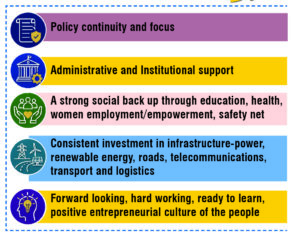
(Q) What institutional mechanisms or administrative culture enabled this stability?
(A) Tamil Nadhu has always been good in processes and practices. Historians have recorded detailed administrative instructions for maintenance of temples, irrigation tank systems, local self governance and many other aspects of life. The successful rulers were also good administrators laying down detailed guidelines for administration. The English rule further strengthened land administration, survey and legal procedures ensuring fair and equitable treatment. The state governments after Independence created many institutions like SIPCOT, TIDCO, TIIC, Infrastructure development board, TIDEL, etc to give focused attention on critical support systems for industrial growth. The state could create many public-private partnership models much before many states because of the availability of such institutions. The state was always strong in education and the thrust given for engineering, polytechnic and technical training institutions has ensured that the state can provide a ready pool of talent to suit any industry or service.
(Q) One of the key features of Tamil Nadu is its well-distributed and decentralised industrial growth. What have been the driving factors?
(A) With no perennial river or canal systems, no great natural resources or advantages, the state has always had to work hard to mitigate the harsh conditions. The developed industrial belts in areas like Sivakasi, Virudunagar, Coimbatore, Tirupur, Ambur, Ranipet, Hosur, Krishnagiri, Tirunelveli, Thoothukudi, etc. are testimony to the entrepreneurial spirit of the people. Governments have helped but the enterprise has come from the people of the state. The even spread of infrastructure like roads, power, railways, airports and ports have helped in spreading the fruits of development throughout the state with no other state showing similar progress.
(Q) Tamil Nadu has done well both in manufacturing and services? What have been some key initiatives which have helped this?
(A) During our road shows before the Global Investors Meet, we used to highlight the point that the state is an all-rounder. It would be within the first three ranks in any parameter, be it number of factories, industrial workers, export, FDI, SEZ’s, engineering colleges, polytechnics, per capita power consumption, patents issued and so on. Our strength has been skilled workers, entrepreneurs, engineers and other professionals who are among the best in the country. Our workers are disciplined, willing to learn and work hard with a team spirit. The society encourages such behaviour with governments and policy-makers averse to interfere in this process contrary to what is seen in some of the other states. The basic foundation of strong entrepreneurship, cooperation and education has helped the state to do well in manufacturing as well as services. 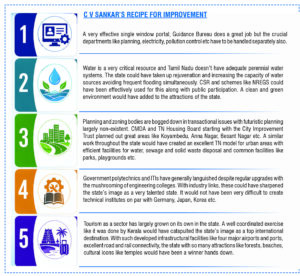
(Q) Tamil Nadu is a welfare focussed state topping in several social development indices. How has this welfare measure helped industrial growth?
(A) The welfare measures of the state cover three broad areas: education, health and safety net. These have ensured that the population can hope to reach its full potential irrespective of the handicaps at birth. Education leads to better parenting and smaller but better provided families. Prenatal and post natal care helps in lesser deficiencies and fuller brain and body development. Safety nets like rations, pensions, basic income support, targeted schemes for welfare of women help in families actively participating in economic activities with least disruption boosting demand for goods and services. Like decentralised industrial activity, the state has well dispersed educational and health institutions including primary health centres helping save money and time in accessing these services.