


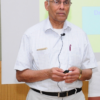

Despite taking up many responsible assignments in all important radiation safety field, the author springs out of this book as a person who wants to share the lessons he has learnt over close to nine decades as a human being. One can pick any page to read and will find it interesting. No read to go from beginning to the end as is the case with most books.
Initially when I looked at the contents and saw Bouquet and Garlands of Poems, I thought of skipping that part and going straight to essay part. I did not want to spare time to read poems which are usually not easy to appreciate at first reading.
However once I started to read the poems, I could not stop reading them. For every one there are several poems of their choice to choose to read from and reflect upon. Let me give just one example of a Poem- Nuclear Weapons. “God converted natural plutonium, Eons back into more benign Uranium, Man not to be outdone, Converted Uranium back into Plutonium, And subrefuged to make lethal weapons, Tested on humanity to see how lethal it works, Like Basmasura tried his boon of weapon on Siva, And led the world to the brink of extinction.
Just the reading of titles of few poems alone is sufficient to arouse the curiosity of the readers to learn more: Truth is Bitter, Old is Gold, Yesterday Kal and Tomorrow Kal, Square peg holed in Round, Turning of Minds and Gita, Abhimanyu in Chakravyuha, etc.
When I started to read essays, it was a different kind of feast equally pleasing. There was old history – some time going back four hundred years back when Dr. Iyer talks about his geneaology- and modern times to 2025.
His school days where he recalls all the nicknames of his classmates and titles showered on his teachers for their unusual attire or food or attitude etc will be nostalgic. His detailed description of traveling by train from deep south in Travancore to Delhi taking more than 36 hours shows how far we have advanced. His parents were worried how he could travel all by himself for the first time. There were many such simple but humane stories to give us a glimpse into the technological development – no mobile phones and not even land lines. Communications is through telegraphs.
Dr. Iyer has many stories to share with his readers. One such story of Velumani who succeeded in building a huge company Thyrocare starting from a humble beginning should be used as a case study in our management schools. He was too poor and could not enroll for Science courses.
Thyrocare Ltd. is a chain of diagnostic and preventive care laboratories. Velumani sold his shares to earn Rs. 4546 crores – what a success story for a person whose parents were too poor to give education to his children.
Dr. Iyer describes his “Most satisfying moment in Life” which should inspire most. When he was celebrating his 88th birthday in 2025, he got a message from one of his old friends recalling how he played a major role 45 years back in conducting an aerial survey of Kerala using for the first time microprocessor based Aerial Gamma Spectrometer. The goal was to monitor large areas for potential radioactive contamination. When the report was submitted on the project, Dr. Iyer the brain child of the project was not mentioned. But he took it in stride.
There are many such stories throughout the latter part of the book. Even to a cursory reader of the book, it becomes obvious the great admiration Dr. Iyer has towards his guru and mentor Dr. A. K Ganguly who was pioneer in India to start Health Physics to deal with radio active health related problems.
Right in the beginning Dr. Iyer by mere luck despite not having the right kind of educational background was able to work for Dr. Ganguly.
Dr. Iyer had the good fortune to work with the famous builders of Bhabha Atomic Research Center ( earlier known as Atomic Energy Center) right from the founder Dr Homi J Bhabha, Dr. P. K Iyengar, Dr. Srikumar Banerjee, etc. In this book, while reading about his interactions with these illustrious stalwarts, one is reminded of how our top managers are different today from yesteryears.
There are insightful comments on a seminal book written by Dr. Iyer, “Saga of India’s Atomic Energy in India” by Dr. Srikumar Banerjee which will compel any one interested in India’s atomic energy to read it. In his Foreword, Dr. Banerjee wrote that “ I realized that such an authentic description of the evolution of the atomic energy program in India, as captured by Iyer within about fifty pages, has perhaps never been done before”.
Role of Dr. Homi Bhabha in putting a strong foundation for BARC to give critical importance to safe operations of all atomic establishments should give comfort to readers. Soon after AEC started to function, Iyer quotes Bhabha stating firmly that “ If there are no funds for environmental safety, we need not start a nuclear power program at all”. AEC is also credited for having contribute to the genesis of Department of Environment in India.
In conclusion I want to recommend this book more as a book of history written by a scientist with a totally different goal to convey his Tryst with Science. No doubt the discussion is driven in the background of BARC/AEC and most individuals are connected with science. However we also learn about the economic, sociological, scientific, and political changes taking place in India.