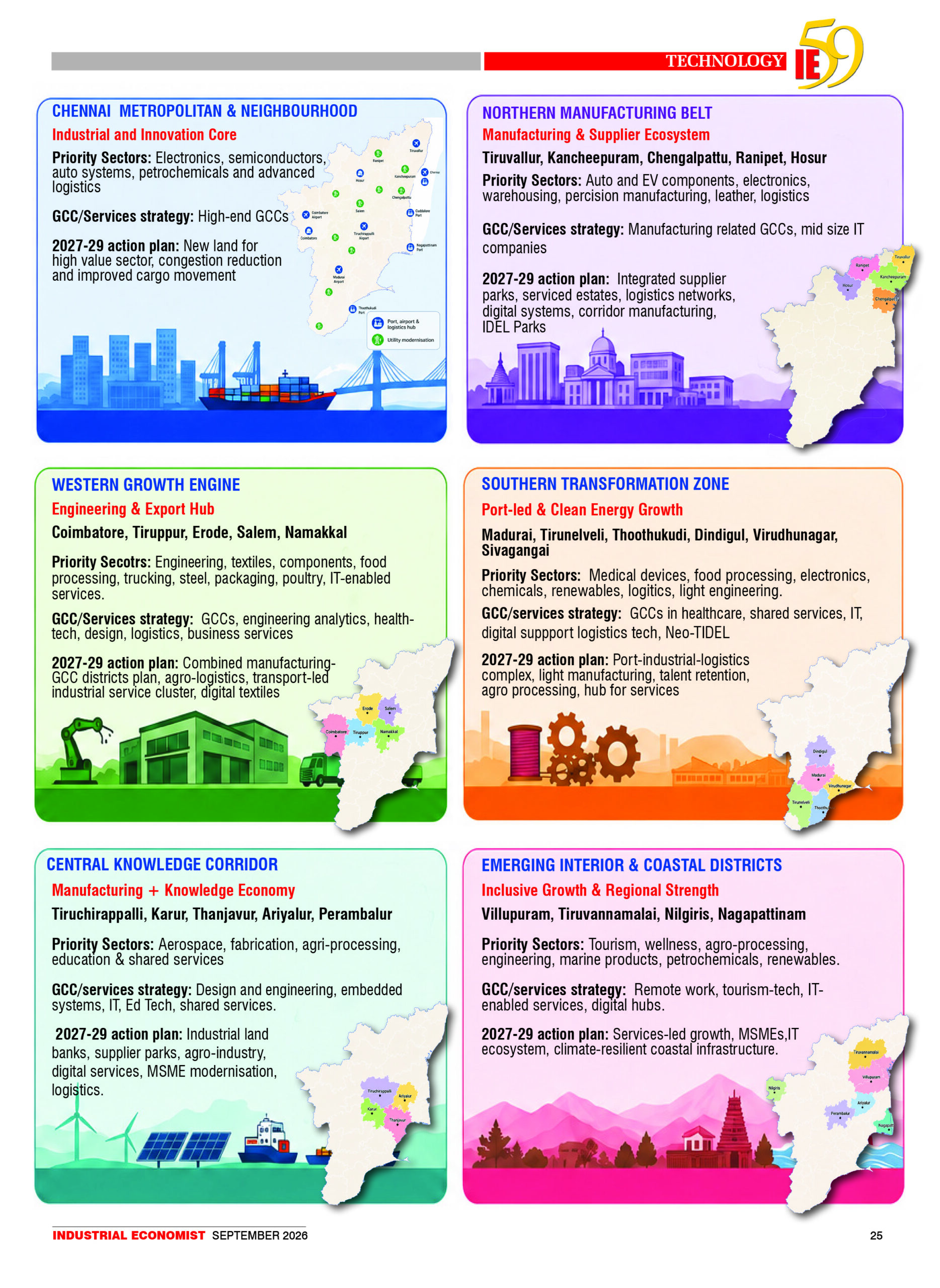

Recommended policy model
To deepen regional development, Tamil Nadu could adopt a multimodal transformation approach anchored on six strategic pillars.
⃝Corridor-led industrialisation: Develop limited number of industrial corridors with clear sectoral specialisation, trunk infrastructure and logistics linkages, rather than scattering projects across unconnected sites.
⃝Tier-II and Tier-III urban industrialisation: With Coimbatore, Tiruchirappalli, Madurai, Salem, Hosur, Tirunelveli, Erode, Thanjavur, Tiruppur and Thoothukudi as anchor cities for regionally distributed growth, combining manufacturing parks, GCC spaces, skill centres and logistics nodes.
⃝Multimodal freight integration: Align industrial policy with the Logistics Policy 2023 by developing multimodal logistics parks, warehousing clusters, private freight terminals, rail sidings and better last-mile roads to industrial and agricultural clusters.
⃝Manufacturing-plus-GCC ecosystems: Encourage firms to co-locate production with design, engineering, testing, analytics, software and back-office functions in sectors such as semiconductors, automotive electronics, industrial automation, medical devices and renewable energy equipment.
⃝Infrastructure bundling: Make industrial approvals conditional on the readiness of power, water, internal roads, drainage, waste treatment, worker mobility, housing and digital systems.
⃝Outcome-based incentives: Shift to incentives based on jobs, exports, local sourcing, energy efficiency, R&D and location in underdeveloped districts, instead of relying mainly on up-front capital support.
These pillars can be translated into a district-specific implementation framework, that outlines workable interventions that the government can implement between 2027 and 2030.