



Yes, you read the title right. We are in times of uncertainty and we need to keep asking how is the weather. Climate discussions appear to have taken forefront across the world but little is being done to mitigate the crisis that has started to dawn on us, and economies prefer not to acknowledge it.
Climate Calling
There was time when scientists, corporates and even countries brushed aside climate concern as an irrelevant thing. Profits came first. Even the Intergovernmental Panel on Climate Change (IPCC) used unclear and weak language on this issue. It was just recently that they unequivocally pinned human activity as the main cause for climate change.
Since the Paris Agreement in 2015, the awareness and concern on climate issues have been high among people. At that time, 196 countries pledged to limit global warming to well below 2, preferably to 1.5 degree Celsius, compared to pre-industrial levels. It is seven years since the event and the ground reality is that our efforts are not enough. According to a recent UN report, with the current way of world functioning, the 1.5 degree Celsius target will be missed and we will end up warming the world, 2.8 degree Celsius above pre-industrial levels. The major concern is there is no clear road map to achieving the goal of limiting to a 1.5 degree Celsius. At this juncture, UN Climate Change Conference 2022 or called COP-27 is to take place in Egypt from 7 November. The COP-26 that happened in Glasgow last year did not yield satisfactory results. The targets submitted by governments were insufficient to limit global warming to the desired levels.
Who should pay the price?
Climate is affected by several natural and man-made factors that accelerate climate change and in turn lead to unpredictable outcomes like floods, storms, drought, sea level rise, melting of ice caps, etc. Across the world, various countries are witnessing these effects, yet the response has been close to nil.
COP-27 will focus on mitigation, adaptation, loss and damage, consequences of Ukraine war, and climate finance. Mitigation and adaptation will look into the efforts taken by governments to control emissions and the new ways in which they try to adapt to the changing world. The loss and damage agenda will look at rebuilding countries that are affected by extreme weather events through climate change. It will also look at the funding to help rebuild them.
The Ukraine war has changed the global order. Energy has become a concern across Europe apart from the huge emissions.
The highly discussed topic is climate finance. In 2009, developed economies pledged to set apart USD 100 billion annually to support the other economies, but this wasn’t fulfilled. And since the cost of mitigation and adaptation is consistently increasing, the burden falls on developing economies to handle this crisis. On the other hand, developed economies are high emitters, are enjoying the freedom of unchecked emissions that fuelled their economies, leaving developing economies to balance growth and emissions. Climate finance is expected to support them in their own growth agendas.
Youth take the lead
With promises being missed, leaders’ unconcern and emissions going unchecked, the youth globally have lost faith on these talks. They are taking the cause upon themselves and COP-26 saw an array of young leaders from across the globe forcing world leaders to act (see here for a detailed report in IE on COP-26 https://industrialeconomist.com/cop-26/).
Securing the future
Climate changes affect all of us. According to the World Health Organisation, “between 2030 and 2050, climate change is expected to cause approximately 250,000 deaths each year from malnutrition, malaria, diarrhoea and heat stress.”
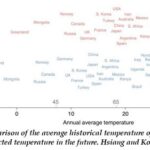
A comparison of the annual average temperature recorded between 1981 and 2010 to the average projected mean temperatures for 2080-2099 as predicted by different climate models show shocking results. All countries will experience higher temperatures in the future. Norway will have historical temperature as in Germany. Mexico will be hotter than Iraq and Indonesia will be similar to Mali. The graph projects that India will experience a high temperature that has never been experienced before.
We should take collective action today, or there would be no tomorrow.


We should take collective action. Well closed,.