


The report highlights India as a structural outperformer, citing strong macroeconomic fundamentals, policy-driven capital expenditure, and rising rural demand as key growth drivers.
“India is no longer the world’s fastest-growing economy just on paper — it is structurally better positioned than most G7 nations. That’s a seismic shift,” said Mitesh Shah, CEO of Equirus Credence Family Office.
India’s rising share in global growth
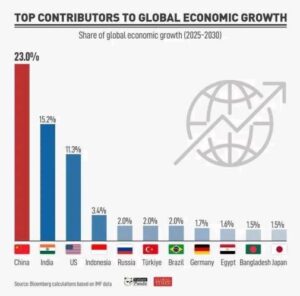
According to the report, India is expected to contribute over 15% of incremental global GDP between 2025 and 2030 — more than any single G7 nation. This far outpaces Japan’s projected contribution of less than 1% and Germany’s 1.3%. Bangladesh is also forecast to surpass Japan, indicating broader shifts in global economic power.
Rural demand and policy capex as growth engines
India’s domestic growth is being led by a resurgence in rural consumption, with FMCG demand in rural areas growing 6%, significantly outpacing the 2.8% seen in urban markets. The rural-urban expenditure gap has narrowed from 84% to 70% over the past decade, signaling deep structural changes.
At the same time, a post-election surge in public investment is taking shape, with central and state capital expenditure expected to rise 17.4%. The Reserve Bank of India has supported this effort with a ₹2.5 lakh crore liquidity infusion via phased CRR cuts.
Global tailwinds and strategic shifts
 The global macroeconomic environment is also tilting in India’s favor. The U.S. Dollar Index (DXY) has declined by 6% from its 2025 peak, while crude oil prices remain stable at $70/barrel — easing pressure on India’s import bill. Meanwhile, multinational corporations like Apple are shifting production to India, taking advantage of cost efficiencies, lower attrition, and geopolitical alignment in the wake of the evolving “China +1” strategy.
Rethinking the 60/40 Portfolio Model
Equirus also challenges traditional investing strategies, particularly the 60/40 portfolio model — a blend of stocks and bonds historically seen as a diversification benchmark. The report highlights its vulnerability, citing the 2022 crash when the S&P 500 fell by 18.1% and U.S. bonds dropped 13% — the worst combined performance since 1937.
With rising correlation between equities and bonds, Equirus urges investors to adopt a more dynamic and globally diversified asset allocation model that can preserve capital and generate alpha amid rising volatility.
“Strategic asset allocation across geographies and growth cycles isn’t optional — it’s the alpha generator,” Shah stated.
The report points out that India’s multi-engine growth — fueled by rural demand, capex acceleration, and supply chain diversification — as a compelling opportunity for both capital preservation and long-term alpha generation.