


Chief Justice N V Ramana commented in a lighter vein: “everybody wants freebies. In this issue, all are on one side.”
Dravidian parties of Tamil Nadu can take credit for utilising this political tool to great effect. With severe food shortages, the country rationed foodgrains for the greater part of the 1960s. The DMK that contested the elections to the state assembly promised three measures of rice a rupee, if voted to power. This roughly worked to around 22p/kg.
Tamil Nadu has been a rice producer with a marginal surplus. There was not an effective system of procurement of foodgrains at that time. Also the DMK was not familiar with fiscal administration. C N Annadurai as chief minister would learn later the impracticability and could not fulfill the election promise.
However, it didn’t matter as his party was well entrenched in power. That one promise did play a major role in swaying the electorate. Such promises with massive impact on the electorate, have come to stay as an important tool for winning elections. In the subsequent five decades and more there had been intense competition between major contestants in Tamil Nadu in conceiving, announcing and implementing to possible extent, measures with wide electoral appeal.
SOME SAMPLES…
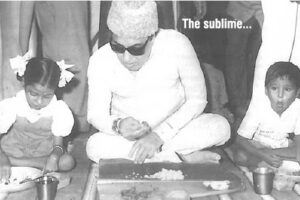 When M G Ramachandran who broke from the DMK, contested the elections in 1977 and 1980, he won the hearts of the people through the free midday meal scheme for school children and destitute that covered around 80 lakh. The civil administration rose to establish in very quick time the infrastructure and the modus needed to implement this gigantic project with sizeable budgetary allocations. This helped achieve a steep decline in the number of children dropping out of schools and to remarkable improvements in the nutrition levels of children. This scheme was adopted by other states and later by the Centre as a national policy.
FREE POWER FOR AGRICULTURE
The formidable popularity of MGR kept the DMK out of power until 1989. DMK supremo Karunanidhi identified another large and potential vote bank, of farmers. Thus in 1989 free power for agriculture formed the major election platform of the DMK and it proved an instant success for the DMK to return to power after 13 years.
From then on it was more intense competitive populism between the DMK and the AIADMK with each party expanding and fine tuning the range of offers which had good impact on the voter. Thus one witnessed free colour television sets further expanded to free mixies, grinders, fans… waiver of cooperative loans, offer of land for the landless, the various sops for the education of girls and welfare of women including liberal assistance for marriages in the form of gold for mangalsutra, saris… Amma canteens offering food cheap soon followed.
The list expanded to free travel in government buses for women and a bizarre Rs 25,000 subsidy for buying scooters by employed women.
HEALTHY HEALTH INSURANCE SCHEMES…
 The Arogyasri Health Scheme in Andhra Pradesh provided health cover for 2.33 crore BPL families covering 6.55 crore lives. The Kalaignar Kapitu Thittam of Tamil Nadu provided health cover to more than 40 million of the state’s population, providing them and their families access to high-quality medicare in government and private hospitals. The Chief Minister’s Comprehensive Health Insurance Scheme emerged as the largest such scheme provided by a state covering close to 60 per cent of the population. This brilliant concept could be traced as an inspiration for The Ayushman Bharat National Health Protection Mission launched by the Centre to provide health cover up to Rs 5 lakh each for 10 crore families, offering health insurance to 50 crore people.
UNIVERSAL BASIC INCOME…
It is difficult to describe a welfare measure designed to ameliorate the lot of the citizens as a freebie. After all, that is a major objective of any elected government in a democracy. The concessions given for education and health, for instance, are legitimate concerns of any administration. To focus on addressing the specific needs of the weaker sections, of the abject poor, the provision of free food, housing and even financial support will be necessary. This should explain the allocation of millions of tonnes of foodgrains free by the Centre since the Covid pandemic began. Economists have also argued a case for Universal Basic Income assuring a minimum income for all. States like Telangana effectively used this as an election platform. Several other states and even the Centre followed this.
FEW CRITICAL ISSUES…
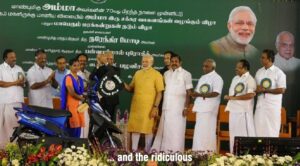 When proposed as part of the election manifesto, the feasiblity of implementing this with adequate financial allocation should be ensured. The impact of the measure on other development allocations also needs to be stated. The issue of targeting it to the sections that deserve these the most is also imperative. In that light, certain promises appear wild. For instance, the Aam Aadmi Party, has been offering free power up to 300 units, free supply of water up to 20,000 litres to domestic consumers, free bus rides to all women… Tamil Nadu has been offering 100 units of power free for all. Delhi and to a comparable extent Chennai, have average income levels much higher than in most other cities/states. Delhi in particular, has much higher levels of average incomes and more even spread of infrastructure. There is a case here for better targeting of the benefits to the most deserving sections.
MOUNTING DEBT…
Competitive populism has denied adequate investments in areas crying for attention. We have been pointing to Tamil Nadu struggling to balance its budget and to generate needed surpluses for development. During 2021-22 the cost of welfare measures, described as grants, was around Rs 105,000 crore that formed a significant portion of revenue receipts of Rs 2,20,000 crore.
For over a decade, total revenue receipts of the state have been falling short of revenue expenditure resulting in borrowings and consequent ballooning of public debt. At the end of March 2022, the state’s public debt has been estimated at Rs 5.71 lakh crore. An immediate consequence is the increase in the burden of interest on such huge debts to around Rs 50,000 crore p.a. eating over a fifth of the revenue receipts. Major corporations of the state, TANGEDCO and state transport undertakings, have accumulated debts of over Rs 250,000 crore.
Significantly, for nearly three decades, Tamil Nadu has not been able to invest adequately on creating power capacities on its own.
THE DEBATE CONTINUES…
The dilemma is not unique to India or Tamil Nadu. US President Joe Biden recently proposed to cancel up to $20,000 per student in debt. This will benefit over 40 million. The debt involved is estimated at $500 billion. There is understandably bitter criticism over its impact on the budget, on timely repayment as also on colleges merrily increasing fees. The debate is bound to continue on defining welfare schemes and freebies.

