



Experiential Education
When realms of technology and humanities meet, the results are ground breaking. Dr Merin Simi Raj and Dr Avishek Parui from the Department of Humanities and Social Sciences have forged barriers and used Augmented Reality (AR) to experience data in different ways. “We worked on a project for tracing Anglo Indian’s history in India and collected rich data. We wanted to showcase the data for both scholarly purpose and at the same time present it in an interesting manner to wider audience. That was when AR came in,” said Merin. The team developed an app, Memorybytes with three segments. The first has a world map which shows the travel of the community. The next is an interactive timeline of events and both these segments are arranged in an easy to access manner for both students and research scholars. Third is a set of photographs which act as an marker and when the app is focussed on them, the AR projection pops up as both visual and sound signals creating an unique experience for the viewer. This was put up as an exhibition in Dakshin Chitra, near Chennai where school children enjoyed interacting with the same. “It was a phygital exhibition and we got a response that students spent lot of time with it,” said Merin.
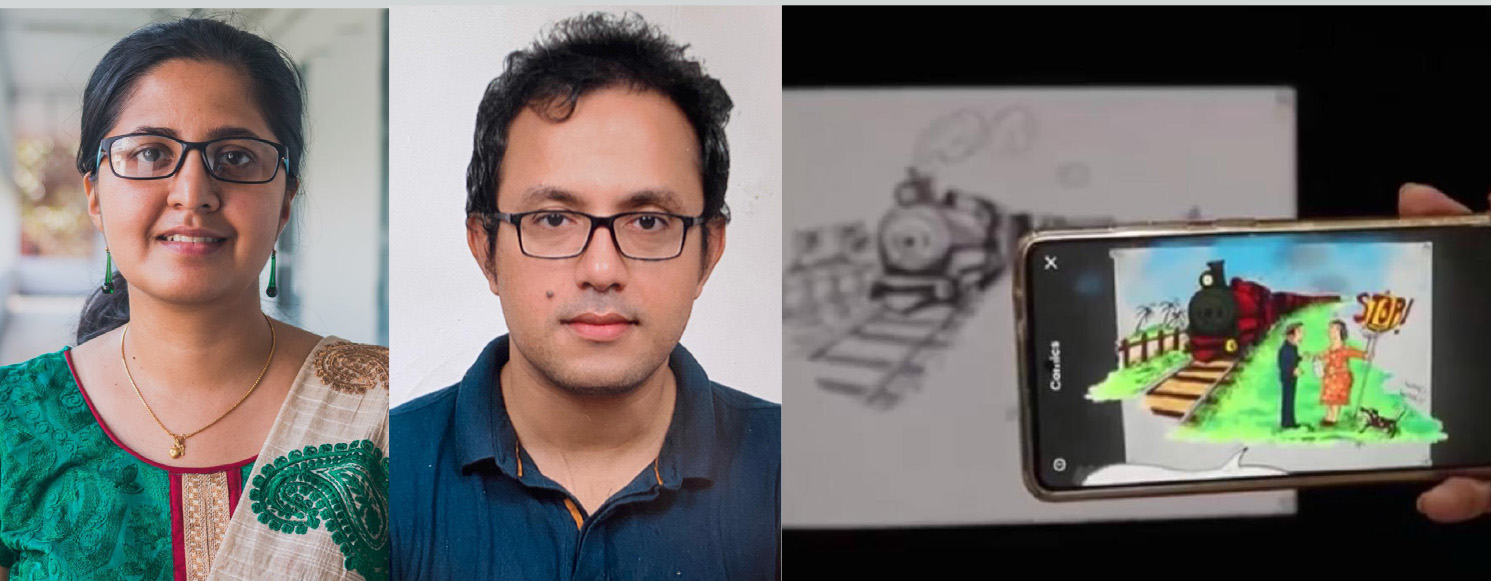 AR has certain benefits over VR. It does not require a separate headset and basic smart phones can be used to scan the markers. Unlike VR, AR has a connect with the real physical world and is not completely disconnected. “We found that the kids enjoyed history through AR in the exhibition. This can be expanded to other subjects and will help students get a better understanding of the subject,” said Merin. The technology is quite affordable and can be reached to students in both rural and urban areas taking quality and experiential education to all corners. “Printing was a great revolution, similarly technology has created a huge impact and opens doors to several experimentation,” highlighted Merin. Apart from pedagogy, this can be extended to museums and Merin adds, “In museums we are used to the “do not touch signs.” But this technology will make the information relatable and humane.”
As pure as milk…
Milk is a symbol of purity and prosperity in our county and adulteration in that has been a concern for long. “About three years back, my brother, a community doctor, asked me if there was a way to identify adulteration in milk before consumption and that set out this project,” said Dr Pallab Sinha Mahapatra, Department of Mechanical Engineering. Pallab and his team decided that the cost of the device would be the primary factor and that it had to be made easily accessible to the consumer. After interaction with experts and going through common adulterants from FSSAI website, the team set out to task. “Our goal was to make a device that easily identifies adulterants by changing colours. This is called colourmetric,” explained Pallab. The team developed a simple strip made out of 3D paper to detect common adulterants like urea, detergents, soap, starch, hydrogen peroxide, sodium-hydrogen-carbonate and salt, among others. With just a drop of milk, within 30 seconds the strip changes colour to highlight the adulterant.
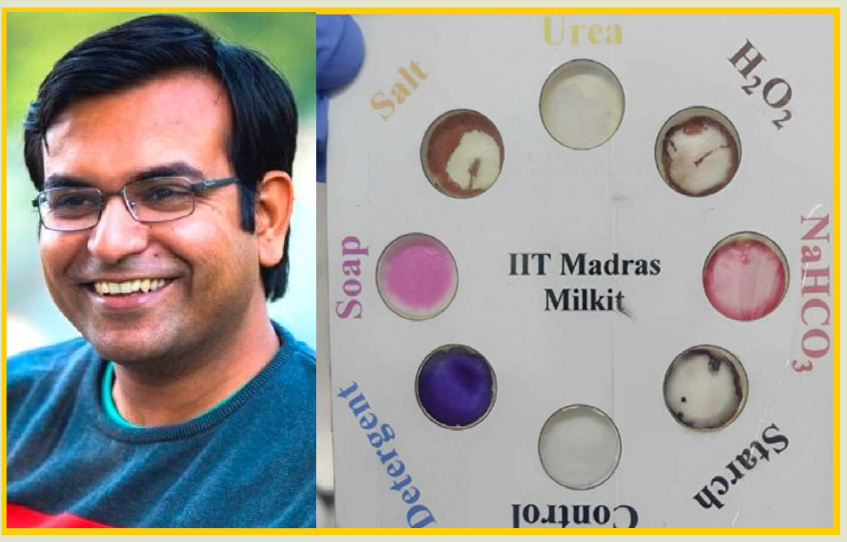 “At the lab stage the product costs about Rs 10 – Rs 15. We have filed patents and the design patent has been granted,” said Pallab and is sure that when it is commercialised the rate will reduce further. But to commercialise the same, more field trials are required. Several factors like shelf life, environment of the consumer and other factors will come into play. It would take about 7-8 months in field trials, will come back for redesign and this cycle will help to build a good product. From labs to market seems like a long process in India but Pallab says that it is the same worldwide. “For long, we had not ventured into this space. But now more research is moving towards commercialisation. Their learnings will help others to thread in the same path reducing the time for reaching the market.” He also pointed to the better industry-academia relationship, “Now the research student has graduated and this product requires another student to do the field study. But if an industry comes in, there would be better resources to execute these.”
The milk adulteration kit is at present designed for use by single customers and is sure to make a mark when it hits the shelves.