



Nuclear power Fast Breeder Reactors
India can lead in FBRs…
In 2016 Japan cancelled its prototype fast-breeder project due to rising costs. France is suspending its 600-MW Astrid Fast Breeder Reactor project pursued in collaboration with the Japanese. World Nuclear News reports that 10 such programmes around the world are under development including those by the Chinese. Strangely, the Prototype Fast Breeder Reactor (PFBR) programme, under commissioning in India, does not find mention in the report.
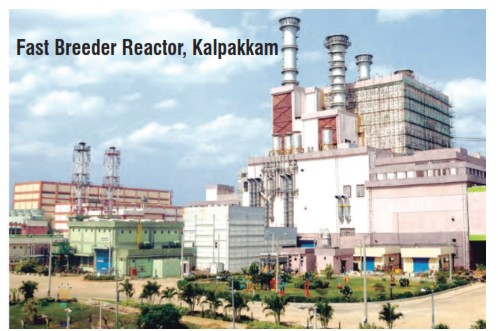
THE NEWS MAY trigger a sense of disenchantment in India but can also brighten the prospect of commissioning soon the first commercial fast breeder reactor [FBR]in the world. The date for first criticality is announced as this year-end.
DEVELOPING REACTORS USING THORIUM
The logic behind developing FBR in the Western World is for utilising the huge stockpile (>90,000 tonnes) of spent fuel from the nuclear reactors containing precious fuel kept as waste. These pose safety and safeguard problems of storage.
For India the rationale for developing FBR is nuclear fuel security. India has limited uranium mineral resources that necessitate importing the fuel which has its uncertainties. But India is rich in thorium deposits. Though thorium cannot be used directly as nuclear fuel, it can be converted into useful fuel along with the spent uranium in a FBR.
INDIA’S NEED FOR FBRS
Developed nations have most of the uranium mining resources. With international market prices falling, today they neither have the need nor urgency to develop FBRs.
France has 70 per cent of her power produced by nuclear power units and is not in a hurry to increase the share. France has been the pioneer in the area of FBRs. It has operated its Phoenix reactor successfully for more than 35 years. Capitalising this success it embarked on a Super Phoenix project which was shut down after 10 years of operation.
If India can bring the FBRs to commercial success it would be a trigger for others to follow.
The Indian FBR programme started in collaboration with the French in 1971. This collaboration was terminated in the aftermath of the Pokhran experiment of India. The technology was indigenously developed and India is now operating its fast breeder test reactor [FBTR] for more than 35 years with an excellent safety record. Riding on this success, India went ahead to design and set up a full-fledged FBTR of 500 MWe. Construction of FBTRs is now complete and is under commissioning. Three more FBTRs are also planned.
INDIA CAN BE A HUB FOR FAST REACTORS
USA has rich experience in nuclear power since the 1950s. Russians have a fast reactor programme and operated their BNR reactor for long and seem to be looking for a collaboration with India. The recent development of the travelling guide concept of TerraPower, USA is similar to India’s FBTR in a more advanced state of fruition. Chinese are the latest to enter this field and have a test reactor like our FBTR operating since 2010. They are also trying to access technology from the Russians and French for perfecting it. India should not lose the opportunity to become the hub of International fast reactor development.
It took a full cycle of 30 years for the world to accept India as a nuclear nation and for removing the controls. Under the changed circumstances, India should forge a collaboration with France to push ahead her fast reactors development programme.
– The author, a former nuclear scientist at BARC and a former Director at the Division of Radiation Safety, International Atomic Energy Agency, Vienna- Dr M R Iyer
