



Udhayanidhi Stalin also inaugurated the upgraded Perumbakkam Electric Bus Depot, developed at a cost of ₹49.56 crore.
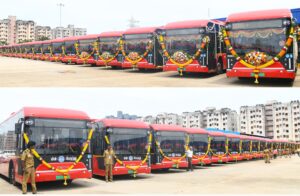
The new electric bus fleet of 130 buses, worth ₹233 crore, features advanced commuter-friendly designs, including a lowered boarding height that can be reduced from 40 cm to 25 cm to aid persons with disabilities, senior citizens, women, and children. Wider aisle space (70 cm instead of the usual 65 cm), single-level seating, and CCTV surveillance for enhanced safety—particularly for women passengers—are among the key features, according to an official statement.
For the air-conditioned fleet, a ₹2,000 monthly unlimited travel pass has also been introduced.
From the Kalaignar Centenary Bus Terminus (KCBT) in Kilambakkam to Thiruvanmiyur on route 95X, 10 deluxe buses and 5 AC buses will operate, while route 555S from KCBT to Sholinganallur will have 5 deluxe and 5 AC buses. On route 19 from T. Nagar to Thiruporur, 5 deluxe and 5 AC buses have been introduced, and route 102 from Broadway to Kelambakkam via Marina Beach will see 5 deluxe and 5 AC buses. The MAA2 route from Chennai Airport to Siruseri IT Park will be served by 15 AC buses, while route 570 from MGR Koyambedu Bus Terminus to Kelambakkam/Siruseri IT Park will have 5 deluxe and 20 AC buses.
Additionally, 5 deluxe buses will operate on route 102E from Thiruvanmiyur to Siruseri IT Park, and route 99 from Adyar Bus Stand to Tambaram will have 5 deluxe buses. Route 102P from Broadway to the Tamil Nadu Urban Habitat Development Board apartments in Perumbakkam will be served by 10 deluxe buses, as will route 19AX from T. Nagar to the same Perumbakkam apartments. Route 99A from West Tambaram to Sholinganallur and route 119G from Kindi Thiru.Vi.Ka Estate to the Perumbakkam apartments will each have 10 deluxe buses in operation.
The roll-out is part of the Chennai City Partnership – Sustainable Urban Services Programme (CCP-SUSP), supported by the World Bank and the Asian Infrastructure Investment Bank (AIIB). Under the scheme, 625 low-floor electric buses will operate from five depots—Vyasarpadi, Perumbakkam, Poovirundhavalli, Central Workshop, and Tondiarpet-1—at a total cost of ₹697 crore.
The first phase of the programme was launched on June 30, when Chief Minister M.K. Stalin inaugurated the Vyasarpadi Electric Bus Depot and introduced 120 low-floor e-buses into service. With the second phase, MTC’s e-bus network has expanded significantly, with work progressing on the remaining depots to install charging stations, maintenance bays, administrative facilities, staff restrooms, transformers, and fire safety systems.
The transition to electric buses is expected to help cut greenhouse gas emissions, with each diesel bus currently emitting about 755 grams of carbon dioxide per kilometre. The move is expected to make a significant improvement to Chennai’s air quality while promoting sustainable urban mobility, added the statement.

